
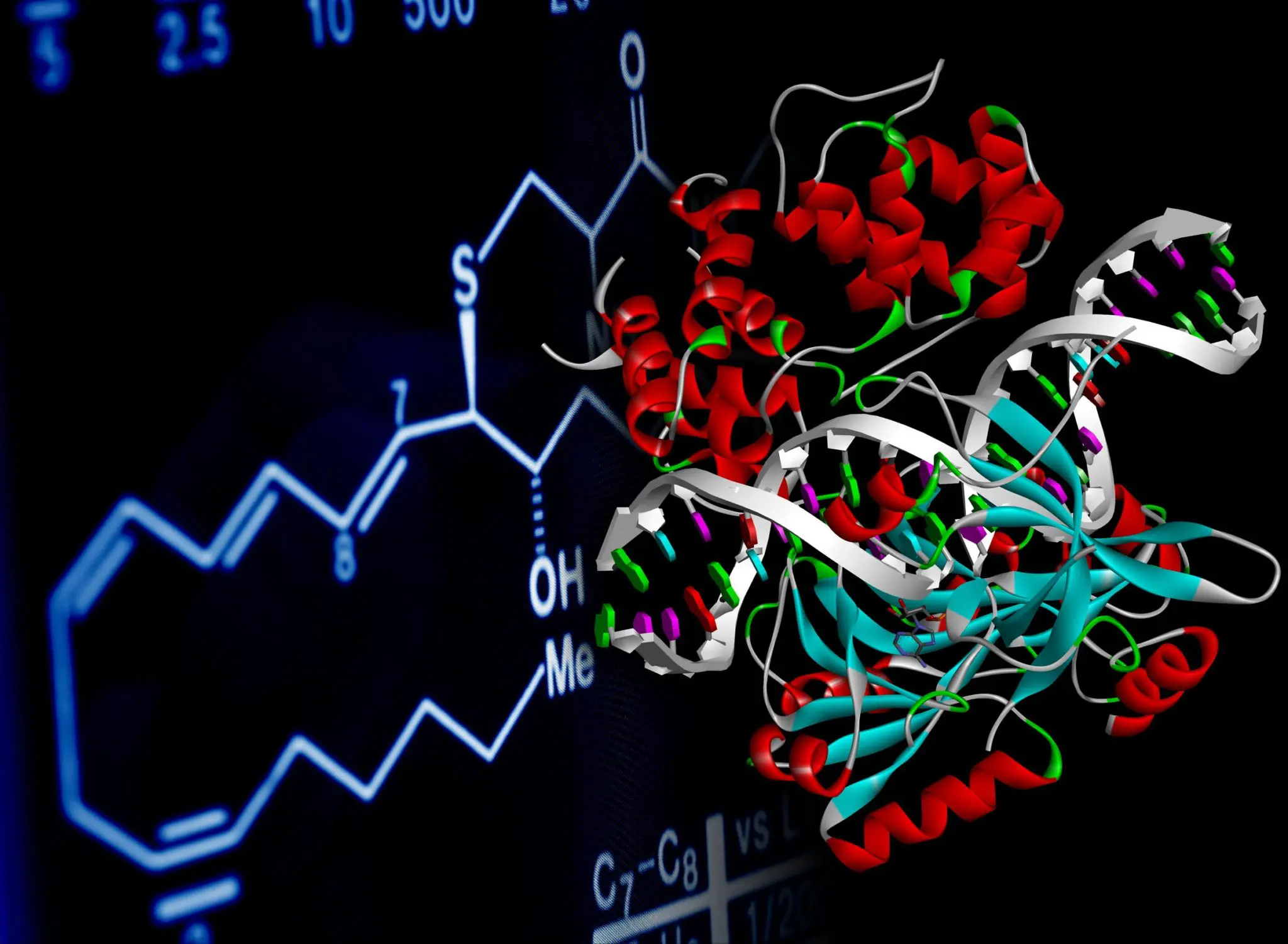
Protein 3D Structure Simulation
Turning computational power into a force that advances research and business.
Within Fumihisa Kojima’s business fields, AI and computational science serve as an important foundation connecting Web3, blockchain, medicine, and biotechnology.
Since his student days, he has been interested in bioinformatics, computational biology, and drug discovery research. At Studio Makyu Co., Ltd., he has been involved not only in web production and system development, but also in GPGPU, HPC, in silico analysis, and research software development.
This experience in computational science is also being applied to current Biozipcode™-related businesses and the commercialization of diabetes and intractable disease research.
This page summarizes the history of AI & computational science business that Fumihisa Kojima has been involved in, and its connection to medical research and commercialization.
What AI & Computational Science Business Means.
Not just simulation
AI & Computational Science Business does not simply mean using AI or having high-performance computers.
Analyzing large volumes of data.
Capturing complex phenomena through computation.
Supporting the formation of research hypotheses.
Identifying relationships that are difficult to see through experiments alone.
Implementing these capabilities as systems required for business.
For me, computational science business means turning this series of activities into a form that can be used in real-world research and business settings.
In the field of medicine and biotechnology, many types of information are intricately connected, including genes, proteins, cells, diseases, drug candidates, and clinical data. It is difficult to understand the whole picture by human observation alone, which makes computational analysis and AI-based support important.
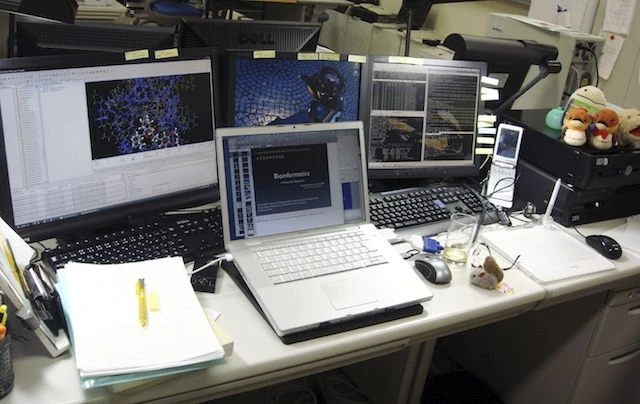
Desk in the Computational Biochemistry Laboratory at the Time
The starting point was bioinformatics
During his undergraduate and graduate years, Fumihisa Kojima studied bioinformatics at Ritsumeikan University.
Bioinformatics is a field where life sciences and information science intersect. It uses computers to analyze biological information such as genes and proteins, and applies that analysis to understanding diseases and supporting drug discovery research.
His interest in bioinformatics, drug discovery, analytical software, and data processing since his student days later led to research support through Studio Makyu Co., Ltd. and the commercialization of Biozipcode™.
In this field, not only researchers but also engineers who support research and people who connect research outcomes to business play important roles. Rather than remaining at a university as a researcher, Fumihisa Kojima chose to work from the business side, supporting research from the outside.
He was also greatly supported by Professor Takeshi Kikuchi of the Computational Biochemistry Laboratory in the Department of Bioinformatics, College of Information Science and Engineering, Ritsumeikan University, where he belonged at the time. The guidance and experience he received as a student became an important foundation for his later work in bioinformatics, computational science, and medical research support.
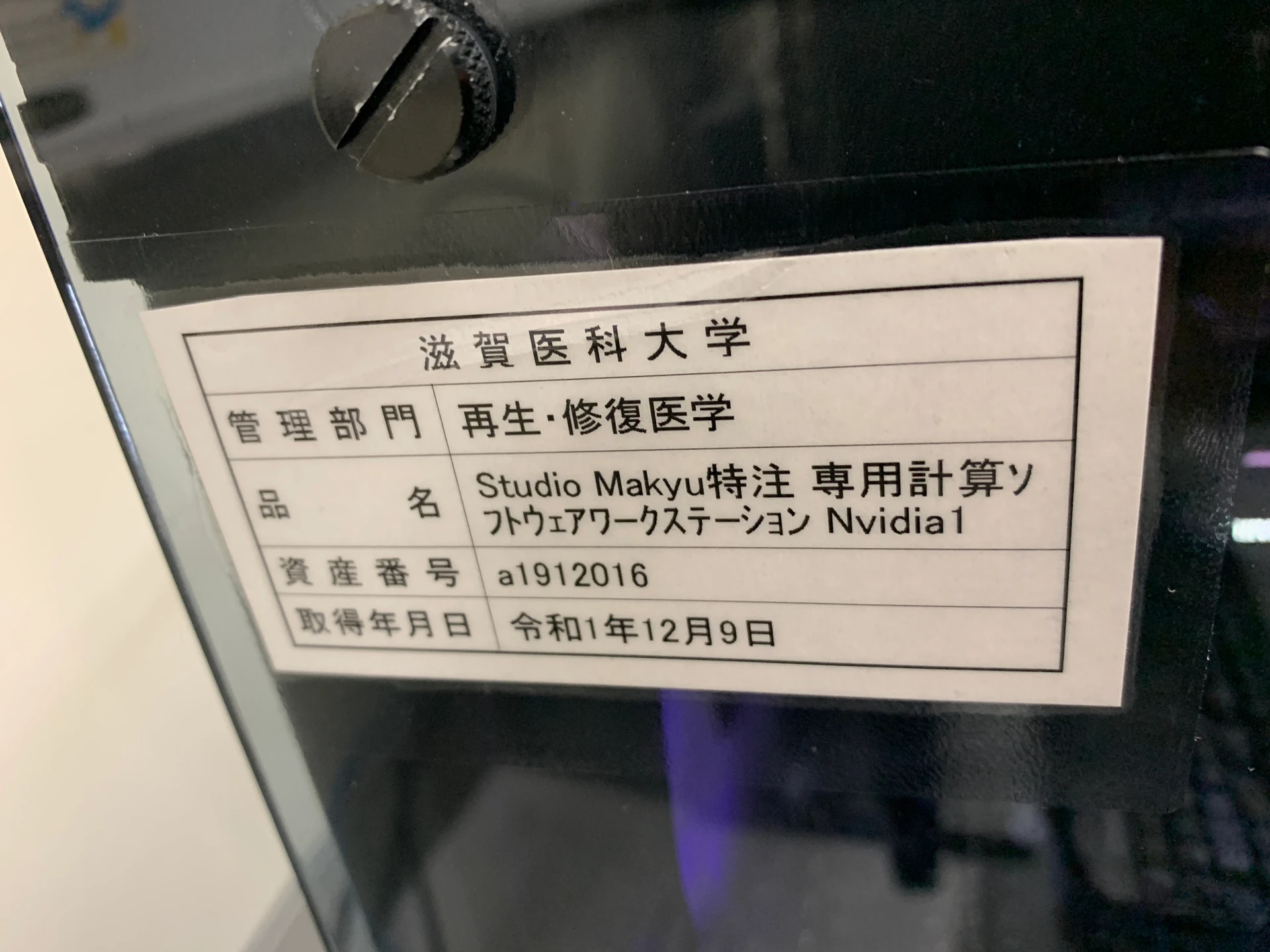
Dedicated Computational Software and Workstation
Technical Support at Studio Makyu Co., Ltd.
Studio Makyu Co., Ltd. began as a company focused on web production, web marketing, and system development.
At the same time, the company also began working at an early stage on computation using bioinformatics and GPGPU.
In its joint research support with Shiga University of Medical Science, the company supported not only in vivo and in vitro experiments, but also in silico research and development. This included the use of analytical tools such as BLAST, development of proprietary software, and large-scale computation using GPGPU.
This kind of support is not always visible from the outside.
Rather than appearing as an author on a paper, it means preparing the environment needed to move research forward.
Making it possible to run computations.
Making data easier to handle.
Building the systems needed to connect research outcomes to business.
This technical support during the Studio Makyu Co., Ltd. period later led to the establishment of Biozipcode Inc..
Using AI and Computational Science.
Experience in GPGPU and HPC
GPGPU is a technology that uses GPUs, originally developed for graphics processing, for scientific computation and large-scale processing.
Fumihisa Kojima became interested in the use of GPGPU in bioinformatics and has been involved in analytical processing and the development of large-scale computing environments.
This experience expanded in two directions.
One was computational science support in the fields of medicine, drug discovery, and bioinformatics.
The other was crypto-asset mining business.
At first glance, biotechnology research and mining may seem completely unrelated. However, both share a common technical foundation in that they use large amounts of computational resources.
How to procure GPUs.
How to design power and cooling.
How to keep the computing environment running stably.
How to improve processing efficiency.
How to make invested equipment viable as a business.
This experience became a foundation for treating AI and computational science not merely as research technologies, but as real-world businesses.
What must come before using AI
The word “AI” is now used broadly, but in medical and research settings, there are things that must be in place before AI can truly be used.
First, the data must be organized.
Second, the purpose of the analysis must be clear.
And third, how the analytical results will be used in research or business must be determined.
What Fumihisa Kojima emphasizes is not making AI look impressive, but organizing information and workflows so that AI can actually be used.
Organizing research data.
Organizing papers and patent information.
Structuring information related to cells and diseases.
Preparing test data and clinical information in a form that can be analyzed in the future.
Turning these elements into screens and systems that researchers, medical institutions, and business companies can use.
In AI & computational science business, this kind of “preprocessing” and “systemization” is extremely important.
Connection with Biozipcode™
In the research and development conducted by Biozipcode Inc., multiple themes are involved, including cell-targeting technology “Biozipcode™”, diabetes stem cells, biomarkers, 5-ALA, HDAC inhibitors, diabetic complications, and cancer therapy.
Advancing this research requires not only experiments, but also support from computational equipment and methods capable of handling enormous computational workloads.
Which cells should be targeted?
Which peptide sequences are likely to bind to specific cells?
Which diseases may have potential applications?
How does the research relate to existing papers and patents?
Which indicators should be evaluated in clinical research?
These questions can be supported by combining bioinformatics, in silico analysis, AI, database development, literature research, and patent research.
Fumihisa Kojima’s AI & computational science business also serves as a behind-the-scenes foundation for making university-originated research such as Biozipcode™ easier to implement.
Seven-Amino-Acid Sequences and Computational Science
One of the key features of Biozipcode™ is the concept of using seven-amino-acid sequences to identify specific cells.
Because there are 20 types of amino acids, a combination of seven amino acids can theoretically produce approximately 1.3 billion possible sequences.
To search among these for sequences that are likely to bind to target cells or tissues and apply them to therapy or diagnostics, not only experiments but also computational narrowing and data organization become important.
It is not realistic to test everything only through experiments.
Narrowing down candidates.
Comparing data.
Organizing the relationship between sequences and cells.
Presenting promising candidates in a form that researchers can evaluate more easily.
In such situations, the use of computational science and AI is expected to play an important role.
Applications in Drug Discovery and Diagnostic Support
AI and computational science are involved not only in drug discovery, but also in diagnostics and biomarker development.
In diabetes research, it is important to determine how to detect diabetes stem cells and abnormal cellular states, not only blood glucose levels. In the future, combining blood tests, cell analysis, biomarkers, image analysis, and clinical data may enable more accurate diagnostics and research evaluation.
In addition, in cancer therapy and intractable diseases, computational science will play an increasingly important role in considering which cells should be targeted, which drugs should be combined, and which patient groups may be appropriate.
AI & computational science business is not a standalone business. It functions as a foundation that supports medical research, diagnostic technologies, drug discovery, clinical trials, and collaboration with pharmaceutical companies.
Future Directions
Going forward, AI & computational science business is considering the following areas:
- Bioinformatics analysis support
- Candidate exploration for peptide sequences and cell-targeting technology
- Database development for papers, patents, and research information
- Organization of diabetes stem cell and biomarker information
- Research on 5-ALA, HDAC inhibitors, and repositioning of existing drugs
- Exploration of potential applications in cancer and intractable diseases
- Organization and visualization of clinical research data
- Information organization for joint research partners and investors
- Integration with KYC, AML, and compliance research systems
- Multilingual information organization for overseas expansion
All of these are positioned less as “creating something with AI” and more as a computational foundation for moving research and business forward.
Positioning of This Page
This page summarizes the relationship between bioinformatics, GPGPU, HPC, in silico analysis, AI utilization, research support, and commercialization support in relation to the AI & computational science business that Fumihisa Kojima has been involved in.
The content described here does not guarantee any specific research outcome, medical effect, diagnostic accuracy, or therapeutic effect.
Applications to medical research and drug discovery require verification by researchers, physicians, pharmaceutical companies, and regulatory authorities.